
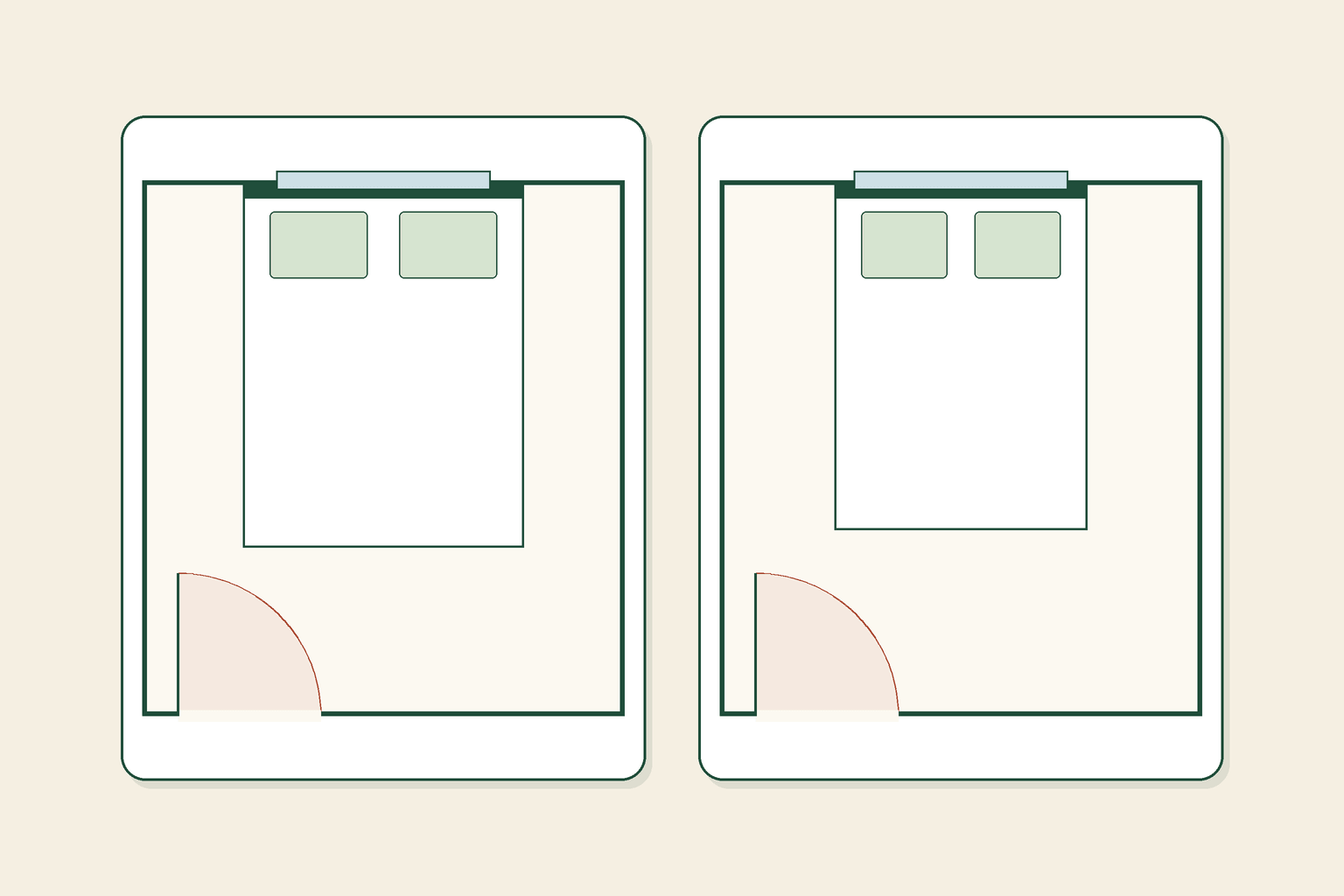
Quick answer
In a small bedroom, a full bed gives you about 3 inches more space on each side of the bed and about 4 inches more at the foot than a queen. That sounds minor, but it can decide whether a room stays above or below the clearance targets we use: 24″ beside the bed as a compact target, and 30″ as a more comfortable one.
A full bed is usually the better fit if your room is narrower than about 9 ft 3 in, or if you also want a dresser and a more comfortable route around it. A queen makes sense when two adults want the extra sleeping width and the room is about 10 ft 3 in wide or more, so you can keep 30″ on each side.
The two beds compared
| Queen | Full | |
|---|---|---|
| Nominal mattress | 60″ × 80″ | 54″ × 75″ |
| Frame used in our examples (IKEA TARVA) | 63″ × 82¼″ | 56¾″ × 78⅜″ |
| Mattress area | 4,800 sq in | 4,050 sq in (about 84% of a queen) |
| Sleeping width per person if two adults share, split evenly | 30″ | 27″ |
The full frame is 6¼″ narrower and 3⅞″ shorter than the queen frame. Real frames vary, and a headboard or footboard can add depth. Other RoomResolved articles use slightly different frame sizes (for example 62″ × 82″), so numbers can differ by a fraction of an inch between pages.
How much room does each bed need?
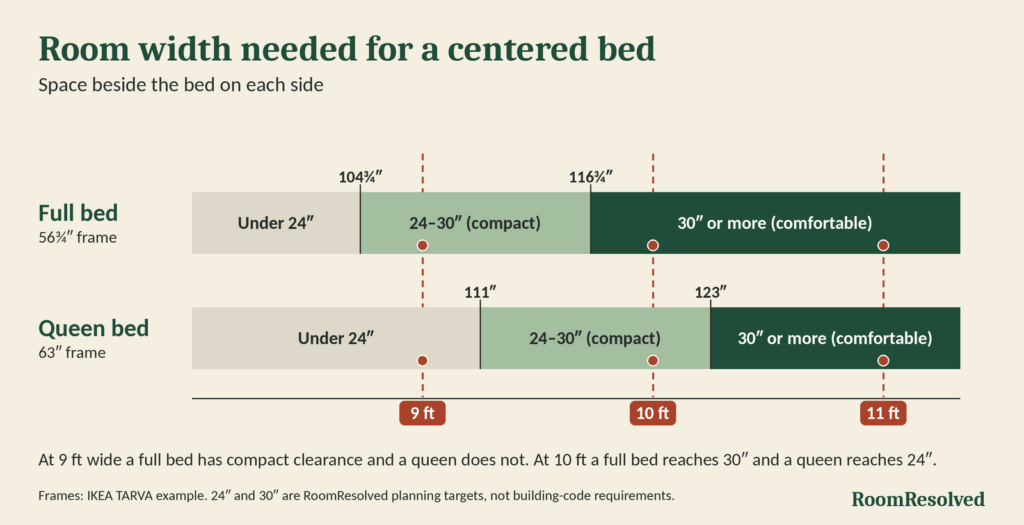
If the bed is centered on a wall, the room width decides your bedside clearance. Here is the width each bed needs:
| Clearance on each side | Queen needs a room at least | Full needs a room at least |
|---|---|---|
| 24″ (compact) | 111″ (9 ft 3 in) | 104¾″ (8 ft 8¾ in) |
| 30″ (more comfortable) | 123″ (10 ft 3 in) | 116¾″ (9 ft 8¾ in) |
The length of the room decides what is left at the foot, and whether a dresser fits there:
| Space you want beyond the foot | Queen: room length needed | Full: room length needed |
|---|---|---|
| 30″, nothing at the foot | 112¼″ (9 ft 4¼ in) | 108⅜″ (9 ft ⅜ in) |
| 30″ in front of a 60″ × 18″ dresser at the foot | 130¼″ (10 ft 10¼ in) | 126⅜″ (10 ft 6⅜ in) |
| 36″ in front of a 60″ × 18″ dresser at the foot | 136¼″ (11 ft 4¼ in) | 132⅜″ (11 ft ⅜ in) |
These are planning targets, not building-code requirements.
Scenario 1: A 9×10 bedroom
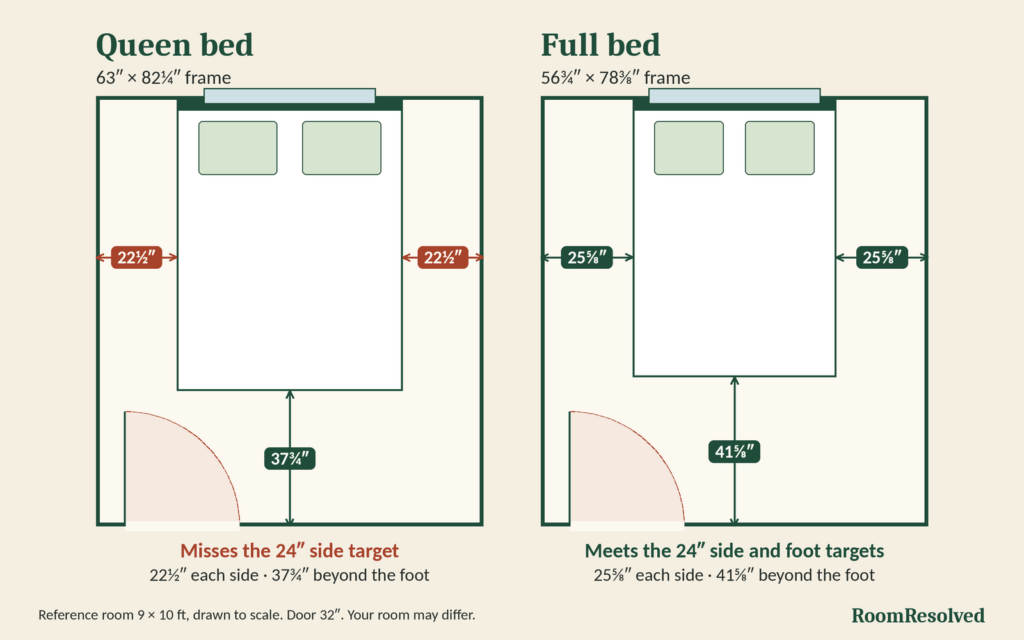
Our reference room is 108″ × 120″, with a 32″ inward-opening door near one corner of a 9-ft wall and a window centered on the opposite wall. The bed is centered with its head on the window wall, and no dresser or nightstands are included.
| Queen | Full | |
|---|---|---|
| Space beside the bed, each side | 22½″ | 25⅝″ |
| Space beyond the foot | 37¾″ | 41⅝″ |
| Meets the 24″ side target? | No | Yes |
| Door swing clears the bed by | about 8″ | about 13″ |
What this means: The queen misses the compact side target by 1½″, while the full bed meets both the side and foot targets.
You could turn either bed so its head is on the 10-ft wall. That widens the sides (28½″ for a queen, 31⅝″ for a full) but shortens the foot to 25¾″ and 29⅝″. In our reference room, a bed centered that way also touches the door’s swing (by about 3½″ for the queen, ½″ for the full), so it only works with a different door position or an off-center bed.
Scenario 2: A 10×11 bedroom with a dresser at the foot
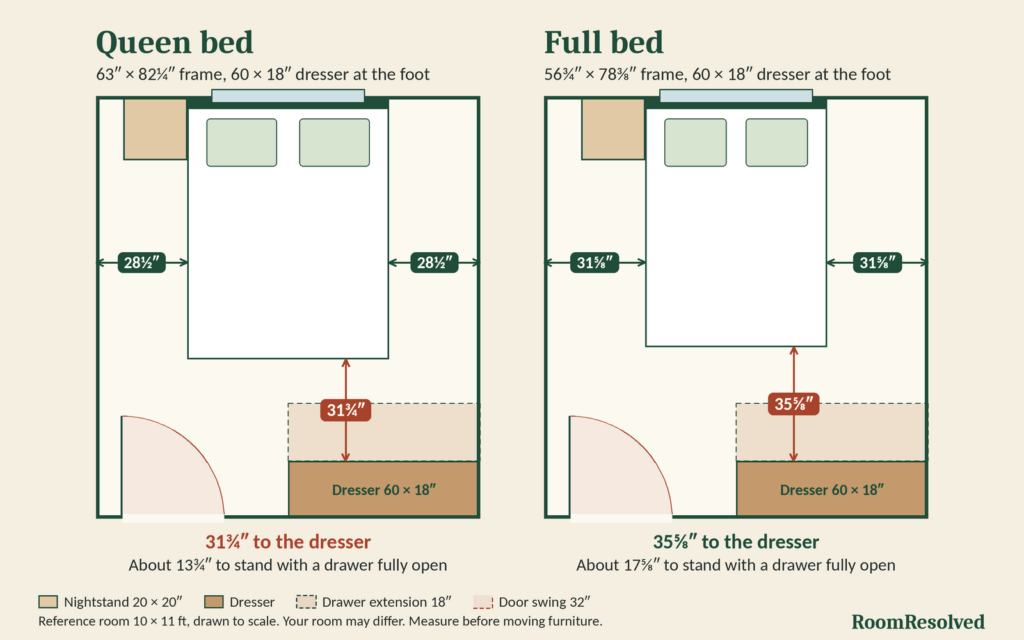
Here the room is 120″ × 132″. The bed is centered with its head on a 10-ft wall, a 60″ × 18″ dresser sits in the corner of the foot wall farthest from the door, and one 20″ × 20″ nightstand sits beside the headboard.
| Queen | Full | |
|---|---|---|
| Space beside the bed, each side | 28½″ | 31⅝″ |
| Bed foot to dresser front | 31¾″ | 35⅝″ |
| Standing room with a drawer fully open (18″ drawer) | about 13¾″ | about 17⅝″ |
| Does a 30″-wide route reach both bed sides and the dresser? | No (24″ route only) | Yes |
| Door swing clears the dresser by | 20″ | 20″ |
What this means: The queen works, but the dresser aisle is compact. The full bed gives 35⅝″ in front of the dresser, which is just under our 36″ comfort target, and it passes the wider route test.
How much does a dresser change your options?
We tested placing the bed and a dresser against the walls at 6-inch steps, with the same door, and counted arrangements that keep at least 24″ beside both sides of the bed and a workable route to the dresser.
| Room | Dresser | Queen | Full |
|---|---|---|---|
| 10×11 | 60″ × 18″ | 8 | 31 |
| 10×11 | 48″ × 18″ | 14 | 48 |
| 9×11 | 60″ × 18″ | 0 | 6 |
| 9×11 | 48″ × 18″ | 0 | 14 |
| 9×10 and 10×10 | 60″ or 48″ | 0 | 0 |
These counts depend on our assumptions and search grid, so treat them as a pattern, not a rule: the full bed leaves several times as many workable arrangements when a dresser is in the room.
What you give up with a full bed
- Sleeping width. Two adults sharing a full get about 27″ each. A queen gives about 30″ each.
- Length. A 75″ mattress is 6 ft 3 in long, which may feel short for tall sleepers.
- Resale and bedding choice. Check what you already own before you decide.
If two adults share the bed every night, those few inches of sleeping space may matter more than a few inches of floor.
Don’t forget the nightstand
The side numbers above leave out nightstands. A 20″ nightstand beside the headboard uses up much of the gap: in the 9×10 room it leaves about 2½″ beside it for a queen and about 5⅝″ for a full. In a 10×10 room it leaves about 8½″ and 11⅝″. In a small room, a wall-mounted shelf or a slim table may be a better choice.
A quick way to decide
- Room narrower than 9 ft 3 in: a full bed is the only one of the two that keeps 24″ on both sides when centered.
- Room between 9 ft 3 in and 10 ft 3 in wide: a queen keeps 24″ per side but not 30″. A full bed reaches 30″ once the room is 9 ft 8¾ in wide.
- Dresser at the foot in an 11-ft-long room: a queen leaves about 31¾″; a full leaves about 35⅝″.
- Two adults and a room at least 10 ft 3 in wide: a queen keeps comfortable sides and more sleeping space.
- Not sure: tape both footprints on the floor and walk the route.
Limits of these examples
- We tested one door position only. A different door position can change which layouts work.
- Frames, headboards, footboards and mattress thickness vary, so use your own measurements.
- The window was not treated as a floor constraint.
- Closets, radiators, rugs and other furniture were not modeled.
- These layouts show physical fit and practical clearance in a reference room. They are not construction drawings, building-code advice or an accessibility certification.
Checklist for your room
- Measure the clear width and length of the room, and the door swing.
- Measure the full outside size of the frame you plan to buy.
- Decide whether you need a dresser or nightstands in the room.
- Compare each bed with the 24″ and 30″ targets above.
- Tape the footprint on the floor and test the route.
Final verdict
A queen bed fits in many small bedrooms, but a full bed buys back enough space to change what the room can hold. In a 9×10 room it is the difference between meeting the side target or missing it. In a 10×11 room with a dresser it is the difference between a compact aisle and one just short of comfortable. Choose the queen when the sleeping width matters more than the floor space, and the full when the floor space is the problem.
For more measured examples, see our guide to how much space you need around a bed, our queen bed and dresser layouts in a 10×11 bedroom, the full bed and dresser in a 9×10 bedroom, and the 10×10 bedroom with a queen bed. You can also browse all Bedroom Layouts.